I’m going to talk about the joys of music and how I prepared to sing a famous piece I’d never sung before.
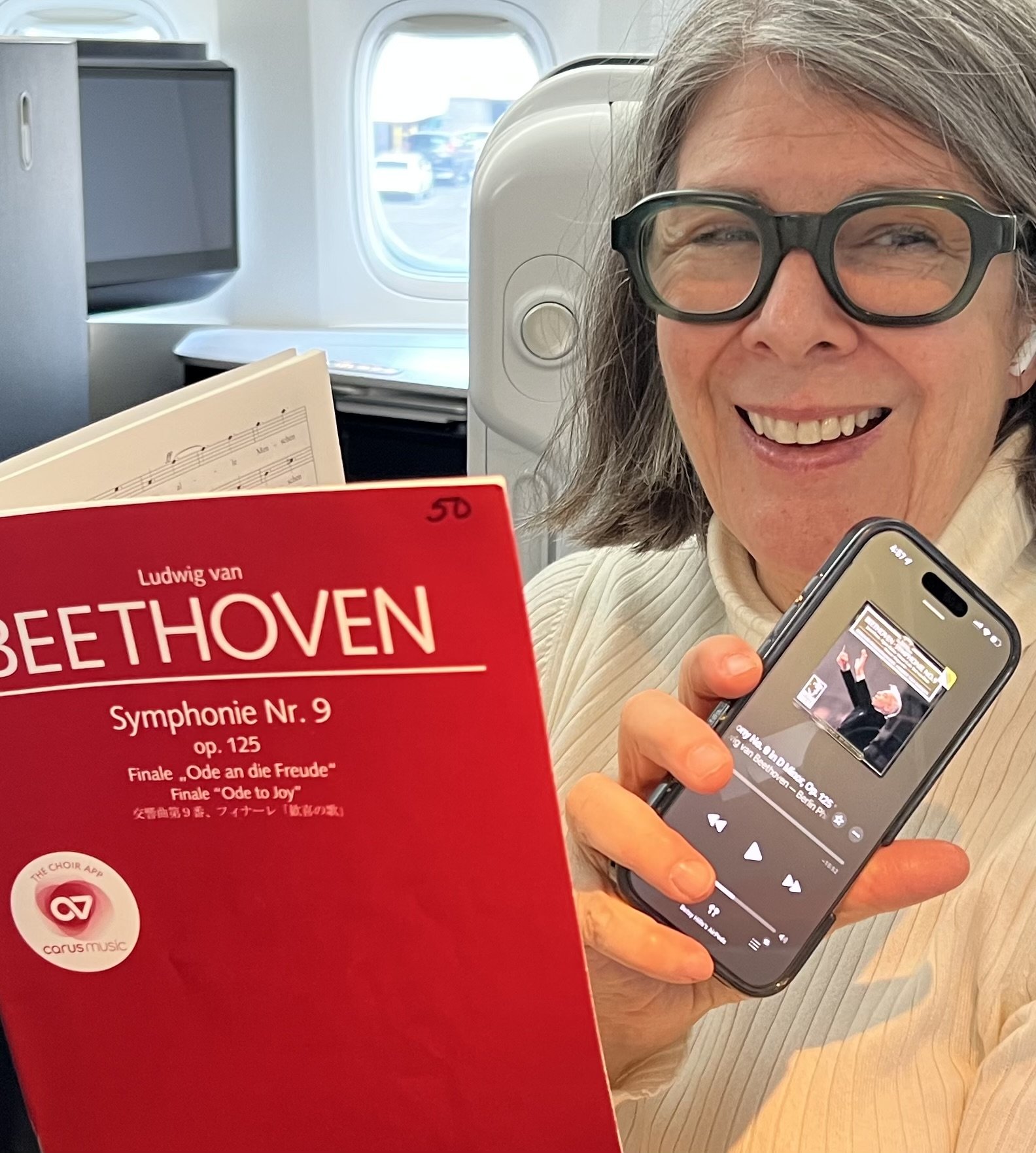
This past month was all about music: The Ode to Joy by Beethoven and Gabriel Faure’s Requiem. The Ode to Joy is, of course, a beloved musical work. The text is from Friedrich Schiller's poem, An die Freude. It's the very last movement of Beethoven's Ninth Symphony, which he composed when he was completely deaf.
I speak German and that’s a big reason I wanted to sing this piece.
Those opening lines are so familiar:
Freude, schoener Goetterfunken,
Tochter aus Elysium,
wir betreten feuertrunken, :
Himmlische,dein Heiligtum
Deiner Zauber binden wieder,
Was die Mode Streng geteilt;
Alle Menschen warden Brueder,
Wo dein sanfter Fluegel weilt
It is all about entering the holy space of joy, the divine eminates in waves. Joy’s magic brings together that which convention has strictly separated. All people will be brothers where joy’s soft wings beat.
And to me, this is about divisions of class, nationalities, races, and genders. We're all people of God, united with this giant embrace and we should all be joyful. And what an amazing message that music sends.
In the last stanza, Schiller uses the word Sternenzelt, starry tent.
We're all under this starry tent, and above the starry tent lives the Father. I love that imagery. An die Freude, be joyful, because we're all together. Analyzing the text, practicing the parts, and rehearsing with the other chorus members were powerful ways to explore the music.
I called it “The Afterlife of the Canon,” referring to the works established by the male art historians of decades past, now given a new life of their own.
This is how I prepared to sing:
I replayed the entire fourth movement over and over again, so that I really had it in my head. Where does the chorus come in? Where are the rests?
Once I had this down, I found a learning video on YouTube. Many of the most often performed choral works have videos in which the part you're learning is in the foreground, while you hear the other parts in the background.
This helps you learn pitch and note values so you get the rhythm right. And you want to know how long the rests are, because you don't want to come in too early when everyone else is silent.
The New Choral Society of Westchester performed in early March with the Purchase College Symphony Orchestra and Chorus under the direction of Associate Professor Mina Kim.
And then, I went right into preparing the Faure Requiem. I sing with the Hitchcock Presbyterian Church chancel choir, under the direction of Dr. John T. King. The Faure Requiem, composed between 1887-90, is haunting and mysterious.
But there is another reason I love this music; the BBC Inspector Morse series, which was on PBS from 1987 to 2000. Inspector Morse, played by John Thaw, was an irascible police inspector in Oxford. He was Oxford-educated but decided to go into police work, which was considered below his station. He loved classical music, and classical themes were often woven into the series soundtrack.
The final episode, The Remorseful Day, aired in 2000. In it, Morse confronts an unsavory character in an Oxford University chapel. The chorus is rehearsing Faure’s Requiem. This unsavory character happens to be the baritone soloist who sings the wonderful movement, Liberar me, a deep, dramatic pleading —
“Lord, deliver me from the fires of hell.”
Morse sits and listens, knowing this character is not a good person. But you sensed that this might also have been Morse’s thoughts for his own self as well. There was always a bleak or tragic backstory to Morse that remained untold.
Earlier in the episode, we see Morse meeting with his attorney about his estate plans. Morse is clear in his intention that there is to be no memorial service for him.
When Morse is in the chapel listening to the chorus rehearse the Faure Requiem, it becomes his memorial service in advance. We don’t realize this, however, until Morse leaves the chapel and collapses on the lawn outside, while we hear the chorus sing the final movement, In paradisum. Sadly, John Thaw himself passed away just two years later.
It wasn’t until I started thinking about this newsletter edition that all these connections came together. That’s one of the great things about music: it can seep in and not let you go.
What’s one thing that you are willing to start?
– Betsy